
Laboratory-scale Flash X-ray Diffraction
From seeing motion to understanding structural change, nanosecond Flash XRD without reliance on large-scale facilities.
Understanding Structural Change in Real Time
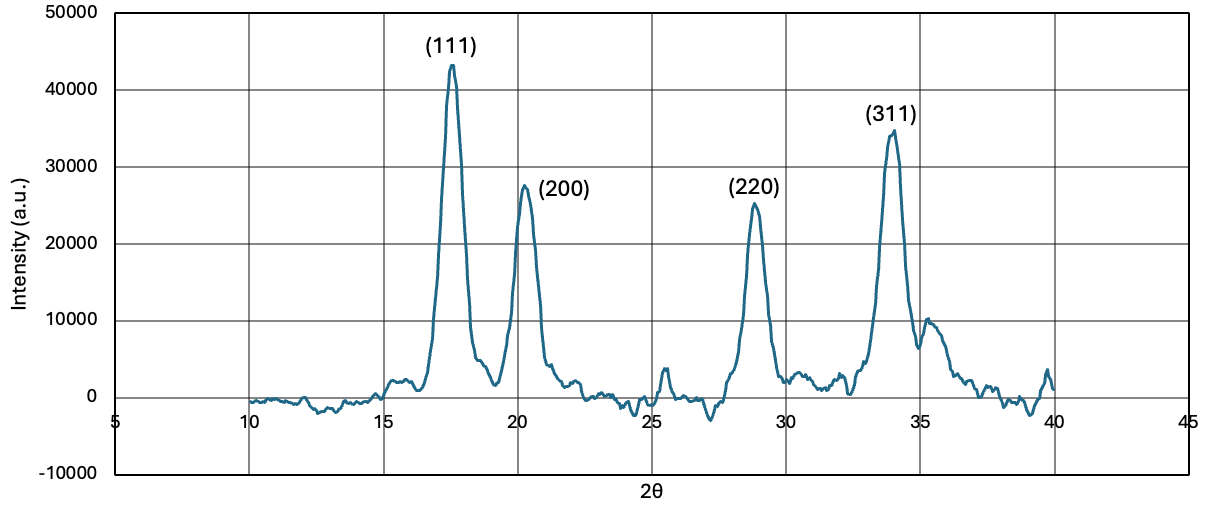
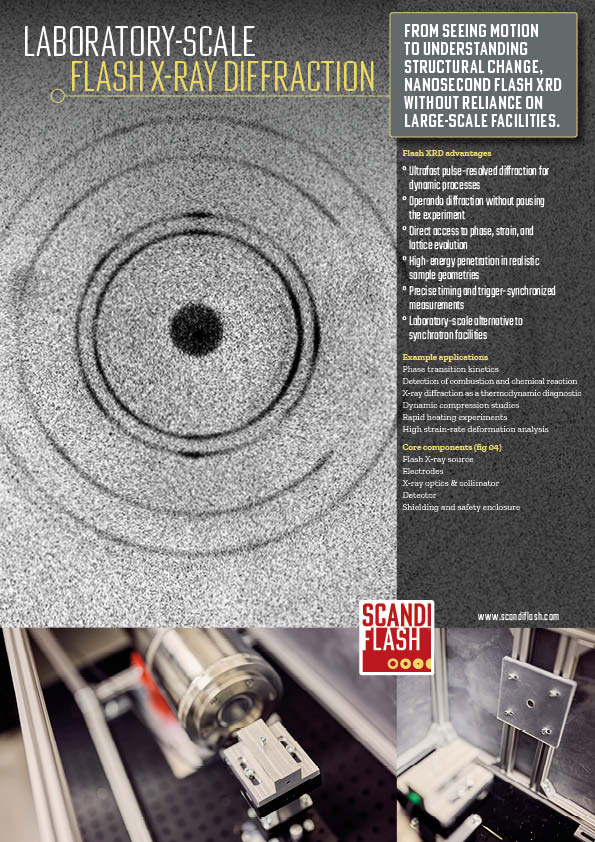
X-ray diffraction (XRD) is one of the most widely used methods for studying crystalline materials. Because diffraction probes atomic lattice structure directly, it provides quantitative information about phase composition, lattice strain, and crystallographic orientation (fig 01).
While conventional laboratory XRD systems operate under steady-state conditions, flash X-ray diffraction enables measurements during transient events occurring on nanosecond to microsecond timescales. This makes Flash XRD a powerful diagnostic for dynamic materials research including shock compression, rapid heating, phase transitions, and high strain-rate deformation studies.
Flash XRD advantages
-
Ultrafast pulse-resolved diffraction for dynamic processes
-
Operando diffraction without pausing the experiment
-
Direct access to phase, strain, and lattice evolution
-
High-energy penetration in realistic sample geometries
-
Precise timing and trigger-synchronized measurements
-
Laboratory-scale alternative to synchrotron facilities
Example applications
Phase transition kinetics
Detection of combustion and chemical reaction
X-ray diffraction as a thermodynamic diagnostic
Dynamic compression studies
Rapid heating experiments
High strain-rate deformation analysis
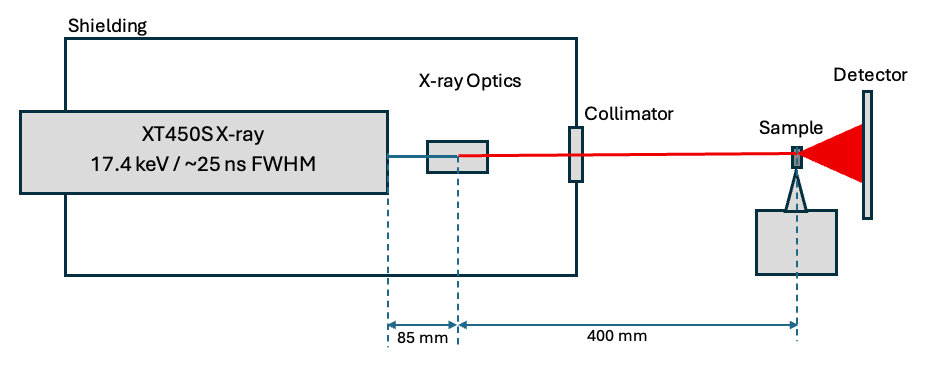
Core components (fig 04)
Flash X-ray source
Electrodes
X-ray optics & collimator
Detector
Shielding and safety enclosure
Raw XRD Curve (fig 01)
(fig 02)
(fig 03)
Component setup (fig 04)
Structural Diagnostics During
Dynamic Events
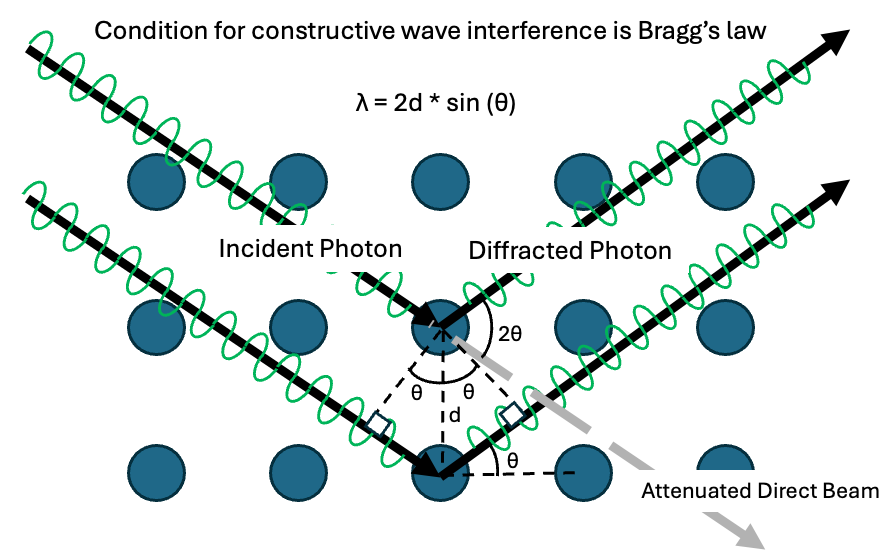
In a diffraction experiment, an incident X-ray beam interacts with lattice planes inside a crystalline material. When the Bragg condition is satisfied (fig 02), diffraction peaks or rings are produced that correspond to specific crystallographic planes.
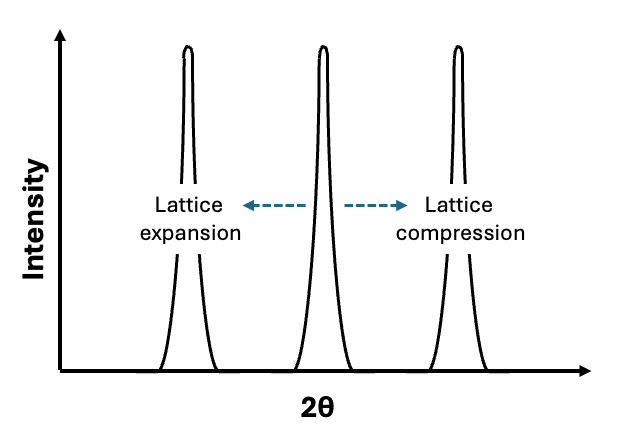
Changes in diffraction peak position reveal changes in lattice spacing caused by compression, thermal expansion, elastic strain, and structural phase transitions. As a result, Flash XRD provides direct insight into the evolving thermodynamic and mechanical state of materials during dynamic experiments.
Time-Resolved Crystallographic Insight
Flash X-ray diffraction (Flash XRD) combines short, intense X-ray pulses with diffraction geometry to resolve structural evolution during fast, non-equilibrium processes. Unlike conventional laboratory XRD, which often requires long integration times and interrupted experiments, Flash XRD enables measurements while the process remains fully active — preserving the true material response.
This allows researchers to:
• Capture structural evolution in real time
• Reveal transient and intermediate states
• Understand cause-and-effect relationships
• Study ultrafast material processes
• Validate theoretical and computational models
From Shock Physics to Operando Materials Research
Flash XRD is well suited for shock physics, detonation studies, impact research, and other extreme-condition applications where structural changes occur on nanosecond timescales.
The technique also extends naturally to slower time-critical systems such as batteries and electrochemical devices, where the most important structural changes often occur during short transient events within otherwise long experimental cycles. By enabling operando diffraction during continuous operation, Flash XRD captures processes that conventional laboratory techniques may miss entirely
Bridging the Gap Between Laboratory and Synchrotron XRD
Flash XRD bridges the gap between conventional laboratory diffraction and large-scale synchrotron experiments by combining crystallographic specificity with dramatically improved temporal resolution. The result is a compact laboratory-scale platform for dynamic diffraction studies that supports rapid experimental iteration, early-stage material screening, and synchronized multi-diagnostic research.
In many ways, Flash XRD is the structural analogue of high-speed imaging — not simply providing faster measurements, but enabling entirely new classes of observable material behavior.
Diffraction as a Thermodynamic Diagnostic
X-ray diffraction provides a non-contact diagnostic capable of inferring thermodynamic variables through measurements of lattice spacing.
Compression shifts diffraction peaks toward higher 2θ angles, while heating and expansion shift peaks toward lower angles (fig 03).
These peak shifts are governed by the material equation of state (EOS), enabling diffraction measurements to diagnose pressure, temperature, strain, and density evolution during dynamic experiments.
We're here to help you
Choosing Scandiflash means you get a flash X-ray system that’s built to meet your needs both today and tomorrow as well as a team that’s ready to support you.
Want to know more about taking your research to the next level? We’re curious to hear what you can imagine doing and seeing with our technology, so get in touch with us through our website or just give us a call at +46 18 557510.
Researching dynamics?
Sometimes you only get one chance – make it count.About Scandiflash
For over 50 years, Scandiflash has been pioneering flash X-ray technology to help scientists and researchers around the globe to see the nearly impossible. Scandiflash Flash X-Ray Systems generate extremely short pulses used to capture dynamics in the harshest of conditions, ranging from indoor lab setups to outdoor large-scale firing ranges. The systems are modular and can be tailored to meet your requirements for number of pulses and peak energy conditions.